
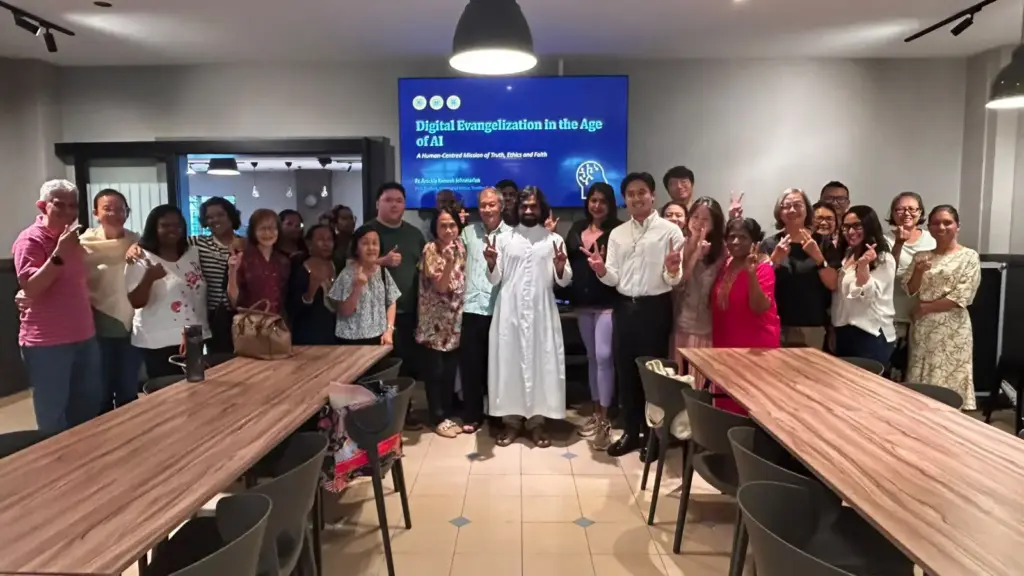
It was Sunday the 8th November, and it was Deepavali, so we took this chance to take the late morning after the Eucharist, to gather to listen to this very special talk by a guest speaker, Rev. Fr. Arockia Ramesh Johnmarian of the the Diocese of Kottar, South India. He is at present a Doctoral student at the XIM University, Bhubaneswar, India.
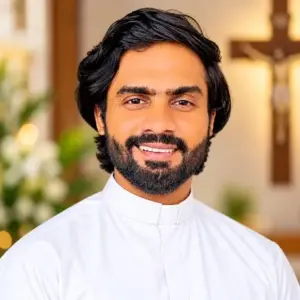
Prior to the talk, Fr Arockia had graciously celebrated the Eucharist and launched his website that comes in both Tamil and English. This caught the attention of the parishioners, for this is a good way to proclaim the gospel in this AI era.
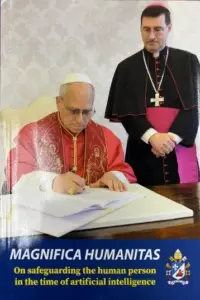
In his presentation, Fr Arockia argues that AI is the newest medium the Church must evangelize, and that the digital evangelist’s task rests on three pillars: truth, ethics and faith. Its main source is Pope Leo XIV’s first encyclical, Magnifica Humanitas(2026).
The talk began with Yuval Noah Harari’s claim that humans survived because of their capacity to communicate. It then traced how the Gospel has always used new media: voice, letters, print, radio and the internet, and now AI. The key change is that AI does more than bring the message; it shapes and generates it. The encyclical is introduced, and the digital world is described as “a new continent to be evangelized” (§238), and the 2025 Jubilee of Digital Missionaries shows that this mission already exists. A “Truth or Fake?” game shows how easily confident stories deceive and leads to discernment as the first mark of a digital evangelist.
There are three pillars to understand more deeply;
Pillar 1: Truth
Truth is first a person, Christ, before it is information. It is also a common good, like a village well: one person who pollutes it harms everyone. Fake AI-generated sermons of Pope Leo show the danger. AI spreads falsehood faster, so truth needs checking and trust.
Pillar 2: Ethics
This section covers how we speak: no humiliating words, the Gospel proposed rather than imposed, and words that disarm. The image of the match and the lamp asks whether a post gives light or only heat. AI is presented as an environment we live in and never neutral, since it reflects its makers. The user is always responsible for what they post. The section ends with “Five commandments of AI for evangelists” and a live survey.
Pillar 3: Faith
AI imitates but does not live. It has no body, conscience or restless heart. Fr. Arockia gave the example of Kintsugi, the broken vessels in Ancient Japan that are not thrown away but put together anew and St. Peter’s denial shows that God redeems our flaws instead of deleting or destroying them. The heart needs real community and the Eucharist, not only screens. Another example was Nehemiah’s shared rebuilding of Jerusalem, set against Babel’s project without God.
These pillars and examples made us reflect and ponder deeper into the wisdom of the gospel and Magnifica Humanitas, taking us through the right path in this most challenging AI era. The participants were all excited and kept on asking questions, clearing their many doubts.
Angela, one of our BEC leader shared, “Fr Arockia’s talk affirmed that sharing Jesus and our Catholic faith on social media can inspire others and be a real form of evangelisation. I was especially moved by the comparison to Nehemiah rebuilding Jerusalem: we can each help build our communities through prayer, listening and working together. Our posts should be signposts that lead people from the screen to the parish, the Eucharist and community. He showed how and why the responsible use of AI is important: be honest about AI-assisted content, never fake a person, verify information, protect people’s data, and keep what is sacred and human at the heart of our faith.
Supporting the idea of true messengers of faith, Eunice Fernandez says ” Attending the AI talk , given by Fr. Arockia Ramesh empowered me to know, use wisely and discern how much to benefit in bringing and sharing the word of God as an Evangelist. AI is not a threat but a tool”.
There were also youth and single adults present and were excited, as the talk was very much related to a need in this most challenging time. “Fr. Arockia’s talk highlighted key issues with regard to AI and the Church. However, we must not despair and be consumed by worry but turn our gaze towards using AI for good, like online evangelisation, and to better assist us in helping those in need with the help of technological advancements,” says Sean Goh, an active member of the parish.
The talk ended with a prayerful call by the speaker calling all members of media/ AV, youth and IT professionals to be “weavers of hope”, like Mary in the Magnificat.